OpenCode Go vs Command Code GOAT: two low-cost coding plans
Both plans cost the same and share almost every model family, yet each wins on half the catalog. Compare quotas and a typical workload's monthly cost.
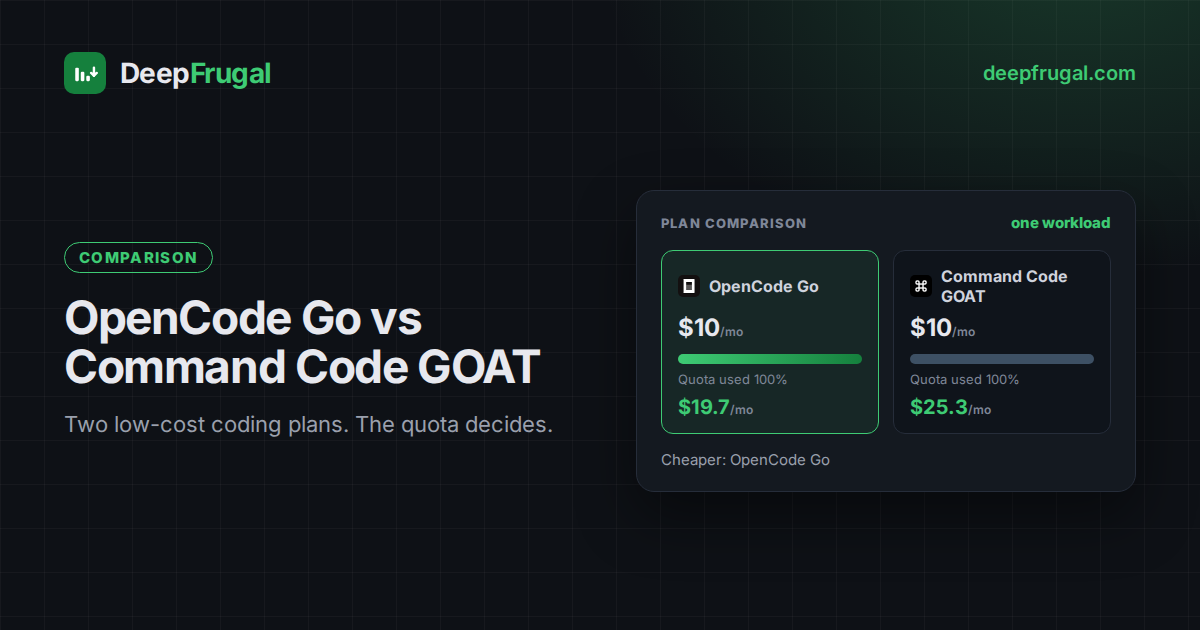
Two coding-agent subscriptions target the same monthly price. Both grant a monthly quota spent at published per-token rates, and they overlap on almost every model. The real difference is how far that quota goes.
What each plan includes
Each plan publishes a monthly quota per model: the dollar value of listed usage the plan covers. A larger quota means a lower effective rate per token. The two plans overlap heavily: almost every model on one is also on the other.
The live table lists every model, its listed rates and its monthly quota per plan:
Plans, promos and prices change over time. Check the live table for current values.
Head to head
The card names the plan that grants the better value per dollar — the monthly quota divided by the subscription price (how that works). Below it, each shared model gets two bars: the longer bar is the plan with the larger quota per dollar, and a star marks it. Switch to Absolute quota to compare the raw monthly quotas, filter to the models one plan wins, and turn off promo prices to compare without the current deals.
 OpenCode Go
+29% more usage per $
OpenCode Go
+29% more usage per $

Value a month's workload against both plans →
The bar splits each model's value per dollar — the plan's monthly model quota ÷ its subscription price: OpenCode Go · Command Code GOAT. The logo is the plan with the higher value; the +% is the gap (— on a draw).
Catalogs: 27 model families on OpenCode Go, 47 on Command Code GOAT, 20 only on Command Code GOAT. Models on one plan only are not compared.
Best case: it assumes you consume the full monthly quota on the model, which is also the best case for value per dollar. Peak/off-peak tiers appear as separate models; a promo can flip the result.
The two plans are close: each wins a similar number of models, so the choice comes down to the models you actually use.
For a typical workload
A raw quota does not tell you what a month costs. The calculator below values one typical workload against both plans. It uses the same prompt mix as the subscription guide, plus a fast model for bulk work. The calculator spends each plan's quota at the listed rates and bills anything above it at those rates. Set the mix to your own month — add, remove and edit models as you see fit.
| Model | Input | Output | Cached read |
|---|---|---|---|
| DeepSeek V4.1 Flash (Off-Peak) | 150M | 8M | 500M |
| DeepSeek V4.1 Flash (Peak) | 38M | 2M | 125M |
| GLM 5.3 Flash | 100M | 5M | 300M |
| Total | 1.2B tokens | ||
OpenCode Go
cheaper
$50.45/mo less
OpenCode Go
cheaper
$10/mo
Command Code GOAT
$10/mo
- OpenCode Go
- Command Code GOAT
- OpenCode Go & Command Code GOAT listed rate
- Cheapest pay-as-you-go route
- OpenCode Go quota limit
- Command Code GOAT quota limit
- Cheaper than the cheapest
- Quota usage break-even
- Plan break-even / loses
- Average at your mix
Both plans cost the same, so the curves share the segment inside the quota.
Pay as you go would cost $69.7 for this mix. The quota is a monthly budget spent at the listed rates; a model with a smaller quota consumes more of it. These figures use promotional rates or quotas. They change when the promo ends — confirm current pricing before you decide.
Compare the two plans model by model on quota →
▾ How the graph is calculated
Each plan draws one curve: the average cost per 1M tokens as the mix scales up. Inside the quota the average is that plan's monthly commitment divided by the tokens used, so it falls and reaches the plan's effective rate at its quota limit. Above the limit the extra tokens are billed at the overflow base chosen in Options — each model's listed rate (default), its cheapest pay-as-you-go rate, or the cheaper of the two — so both curves follow that base.
Each plan grants one monthly budget: each model's published quota is that same budget restated at its rates, and the budget is allocated in the model order shown, so a different order or blend moves the curve. A token type a plan does not price still counts in the volume but adds no cost. The token axis is logarithmic, so a wide range of usage fits on one chart.
Each plan's listed rate is a horizontal reference, drawn once as a shared neutral line when the two rates match. The pay-as-you-go line is the shared cheapest real rate per model (fee included; sales tax excluded) — an exact variant match when a pay-as-you-go gateway publishes it, otherwise the model's nearest published row — so it can combine more than one gateway. When it equals the cheaper listed rate the chart drops it.
Only the cheaper plan for the mix carries the markers: the quota usage break-even is where its average meets the cheaper reference, the plan break-even is where it starts to beat it, and loses to the cheapest is where it stops. The shaded band is where the cheaper plan beats the cheapest reference, split at that plan's quota limit: solid up to it, fainter beyond. The your mix guide is shared by both plans at your stated usage, labelled with its monthly token volume, with a horizontal guide at the average cost of the cheaper plan per 1M. Each quota limit is a dashed vertical line. With Promo prices off, every figure uses the pre-promo list rates and quotas, and each commitment reverts to the list subscription.
Experimental. Confirm every figure against the provider's own pricing before you rely on it. DeepFrugal is not responsible for calculation errors.
Turn promo prices off to see the pre-promo result, when the quota a promo boosts stops covering the workload.
Summary
The plans are close on price and on catalog. Command Code GOAT carries more model families, but the per-model quota decides which is cheaper for the work you do. Check your main model in the chart above, then confirm the live rate in the live table.
Frequently asked questions
Which plan is cheaper?
They share a monthly price and overlap on models, so it depends on which models you use. The head-to-head card names the plan with more value per dollar.
What actually differs between them?
The published monthly quota per model. A larger quota means a lower effective rate for the same subscription.
Do both plans carry the same models?
They overlap on almost every model family, and each wins on about half the catalog.
Can I compare them on my own workload?
Yes. The plan comparison calculator values one monthly workload against both plans.